
Makepay
Official MakePay payment provider for Medusa v2 hosted checkout.
MakePay for Medusa


Official MakePay hosted cryptocurrency payments for Medusa v2. One package contains the payment provider, MakeCrypto OAuth connection, database module, API routes, and Medusa Admin pages/widgets—there is no separate Admin package.
Version 1.0.1 supports:
- MakeCrypto OAuth with PKCE, DPoP-bound tokens, automatic refresh, and a grant-scoped webhook subscription.
- The original MakePay API-key configuration as a compatibility mode.
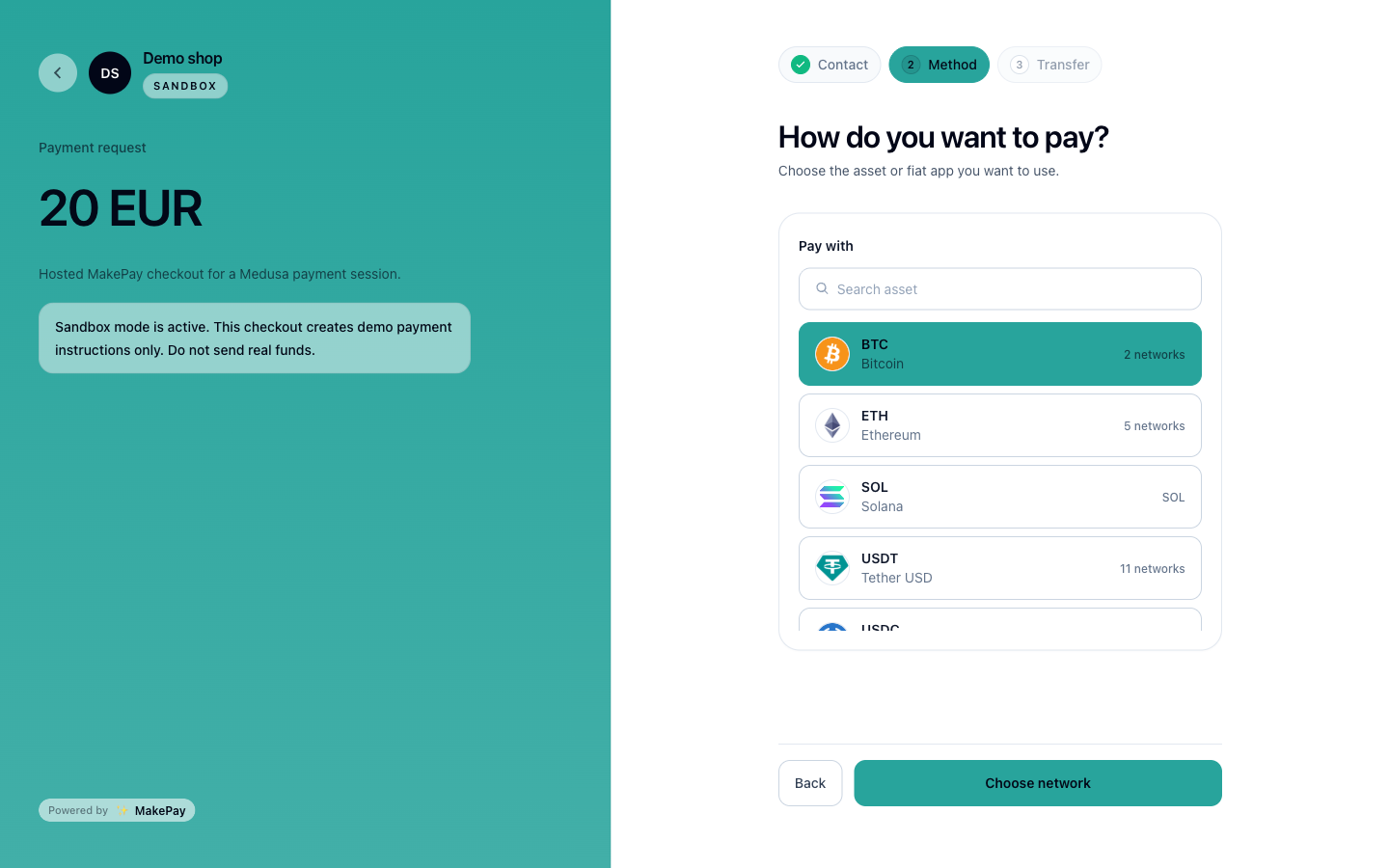
- Medusa's flow, so the order exists before the shopper is redirected to hosted checkout.
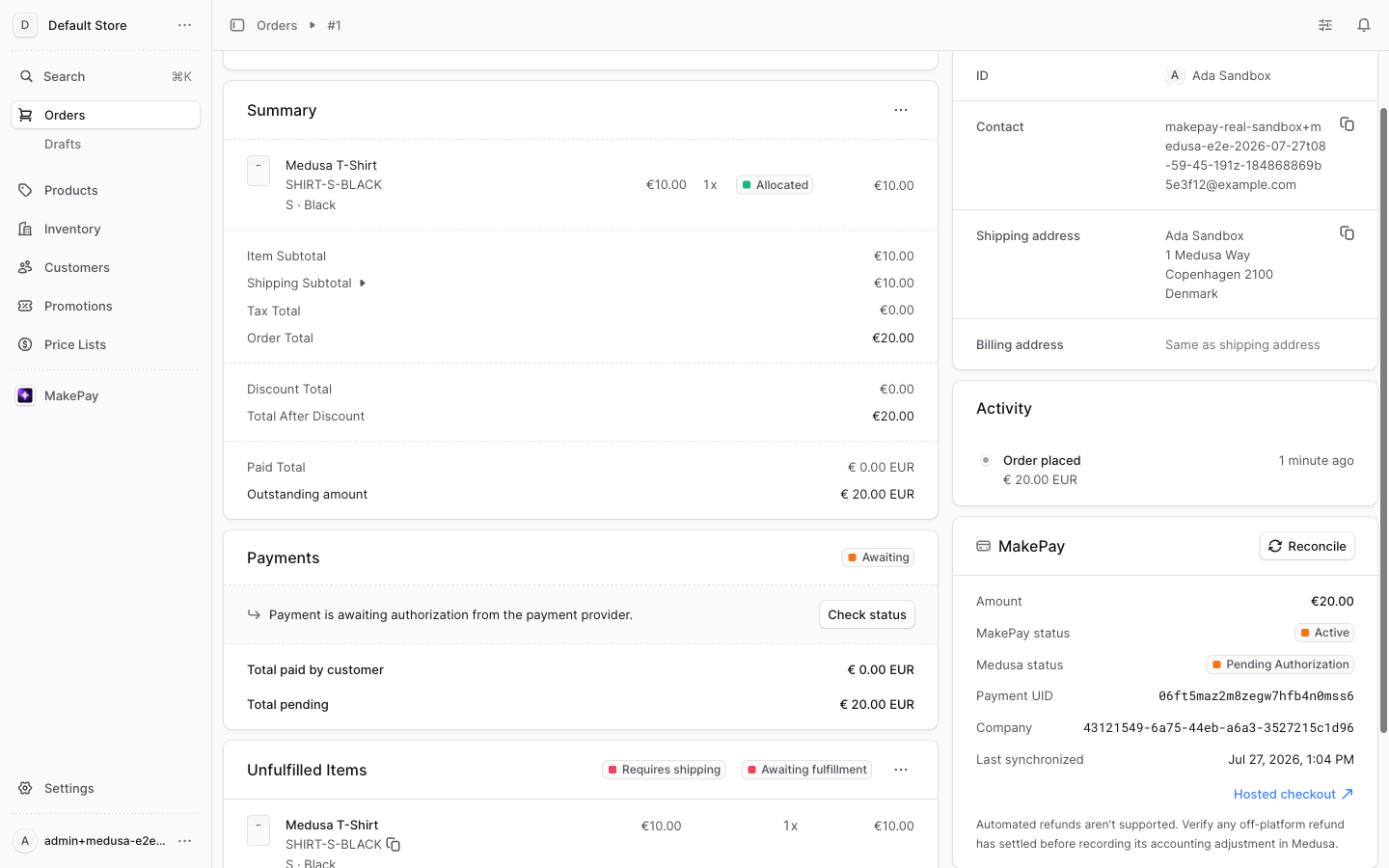
- A read-only MakePay payment list, connection settings, order-detail widget, and server-side payment reconciliation in Medusa Admin.
Automated refunds are not supported because MakePay does not currently expose a merchant refund API.
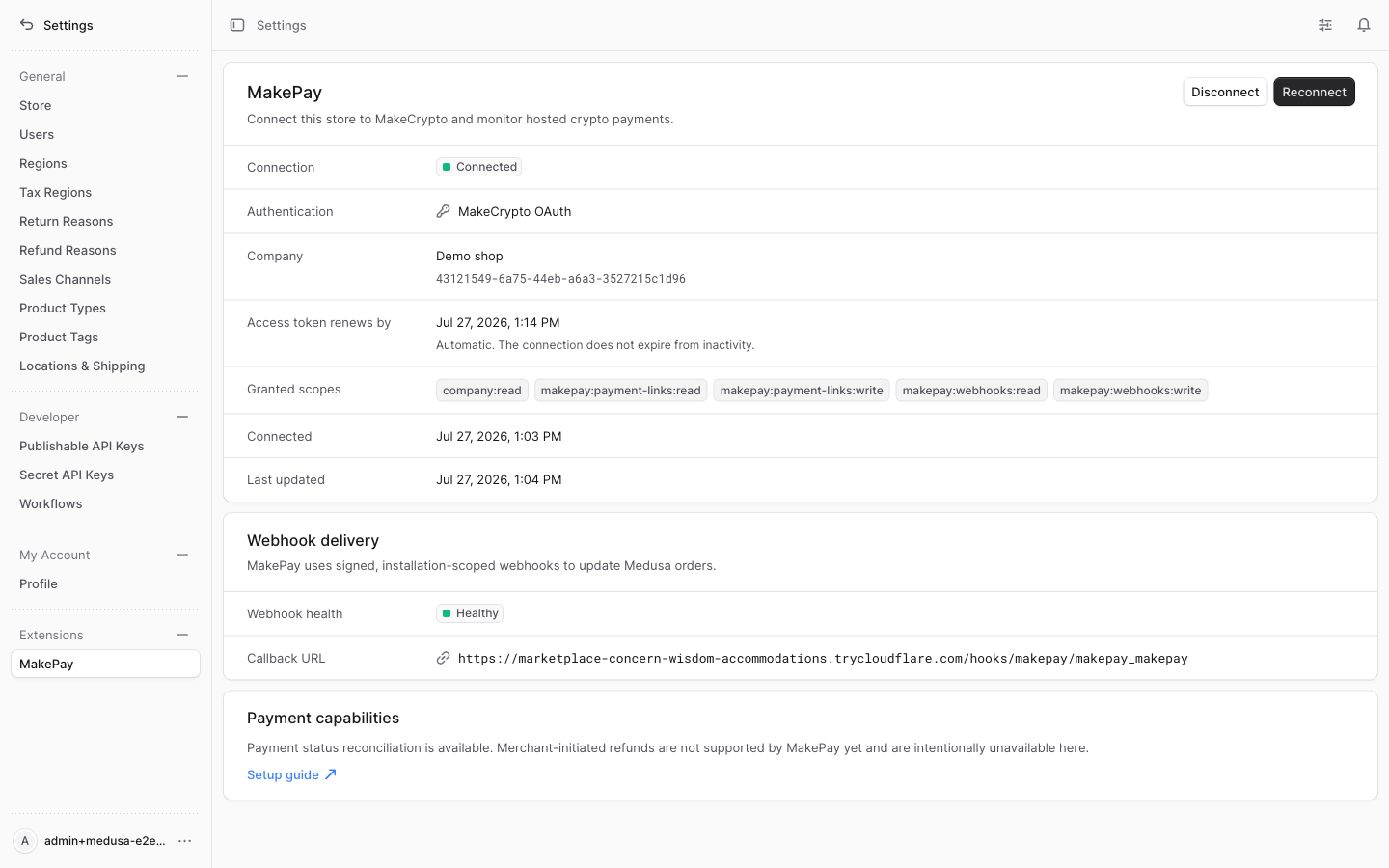
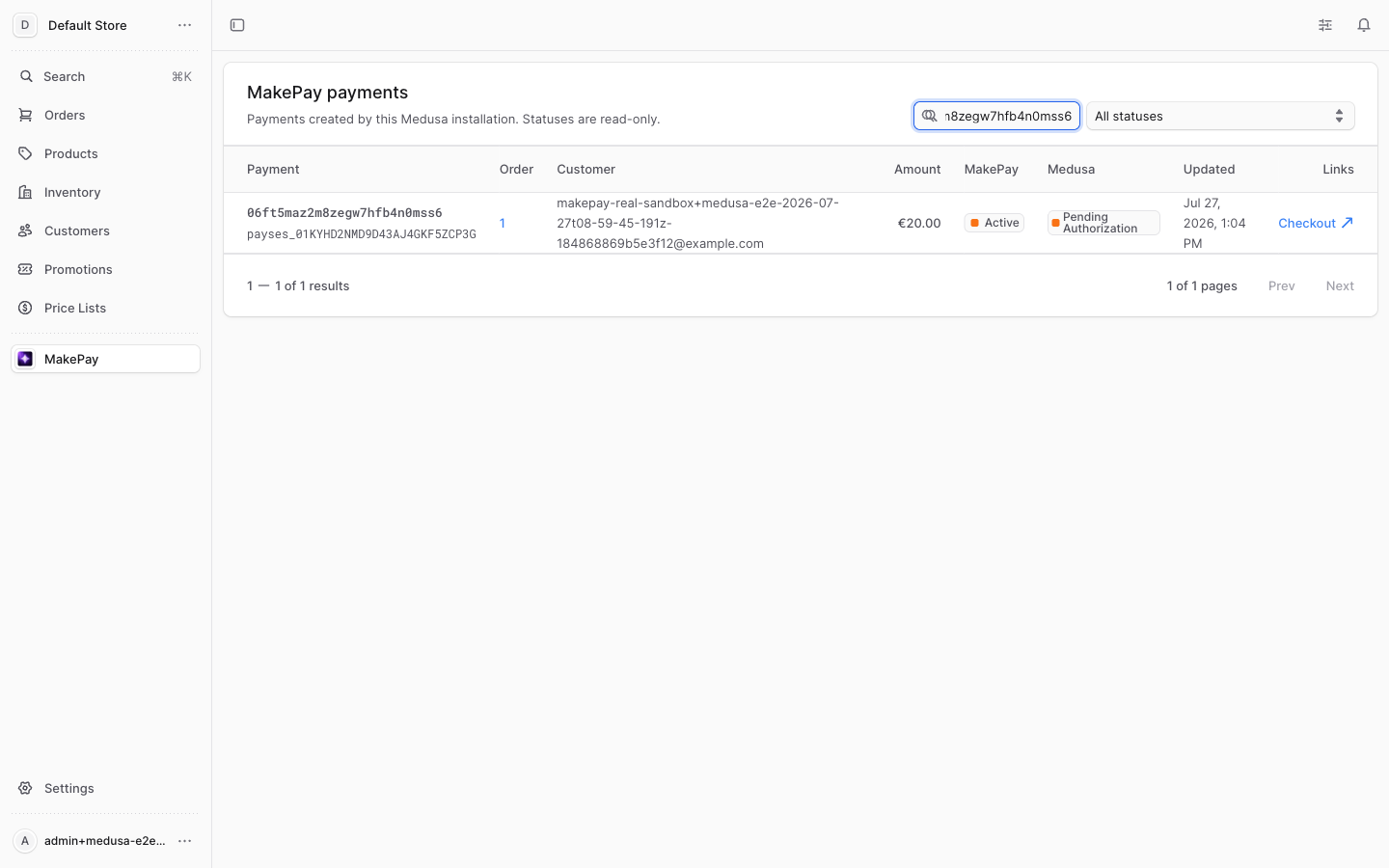
Admin and checkout preview
These release-verified views come from a real MakeCrypto/MakePay sandbox using synthetic customer data. No cryptocurrency is sent.
| Connected OAuth settings | MakePay payment list |
|---|---|
 |  |
| Order payment widget | Hosted sandbox checkout |
|---|---|
 |  |
Requirements
- Node.js 22 or newer (CI tests Node.js 22 and 24)
- Medusa 2.17.2 or newer within the 2.x release line
- PostgreSQL, as required by Medusa
- Medusa's Locking Module enabled (OAuth token rotation fails closed without it)
- A MakePay merchant account fully set and active
- A public HTTPS Medusa backend URL for production OAuth and webhooks
Upgrading from 0.2.0? Read MIGRATING.md before installing.
Install
The package must be registered twice in : as a plugin so Medusa discovers its module, migrations, APIs, and Admin extensions; and as a provider under the Payment Module.
OAuth configuration (recommended)
Generate a unique encryption key for each environment and keep it in the backend secret manager:
The PostgreSQL locking provider is bundled with ; do not install a separate locking-provider package. OAuth startup fails when is missing or resolves to Medusa's in-memory provider. A distributed lock is required so concurrent workers cannot refresh or rotate the same OAuth token family at the same time. The same value must reach both the plugin and the payment provider options, as the shared object does above. In API-key mode it is optional only for a pure legacy installation with no stored OAuth authorization state, connection, or payment history. Configuring it adds cross-process payment-effect serialization and enables safe Admin reconciliation; API-key checkout requires it after OAuth has been configured.
An official Medusa OAuth connection has no inactivity expiry. Its short-lived access token is rotated transparently under the distributed lock, including when the store first wakes after being offline for more than 30 days. The connection remains usable until the merchant disconnects it, MakeCrypto revokes its installation or token family, or a security reset invalidates the grant. is therefore the next automatic renewal time, not the connection's expiry date; do not build reconnect prompts around it.
Reconnect key rotation is staged to avoid downtime. The plugin durably saves the proposed private key before registration, proves possession of that key, and uses the currently accepted key to authorize a replacement. Closing or rejecting the consent screen leaves the old token family usable. If a pending replacement key is lost, the accepted previous key can register another one; successful consent binds the new key and revokes the complete old access and refresh-token family.
If consent succeeds but the browser callback never completes, MakeCrypto may have revoked that old family before Medusa received the replacement tokens. The old authorization cannot be refreshed back into existence. The retained registration keys let Reconnect register and complete a fresh consent without deleting the connection row. If a disconnect is already pending, Admin intentionally offers both Retry disconnect and Reconnect; finish the reconnect first, then disconnect again if the store should remain disconnected.
Apply the additive plugin migration before starting the upgraded backend:
npx medusa db:migrateThen:
-
Open Medusa Admin at Settings → MakePay.
-
Select Connect MakePay and complete company selection and consent.
-
Confirm the settings page reports the correct company and a healthy webhook.
-
Before building or deploying the storefront, open Settings → Regions, edit every region the storefront uses, and enable under Payment Providers, then save the region.
-
Verify each region with the storefront's publishable key:
Do not continue until the response includes .
Registering the package and payment provider only makes MakePay available for region configuration; it does not enable MakePay on any region automatically. The provider lookup uses the current cart's , so retrieve the cart again and confirm it belongs to a region you edited. Reload or re-enter checkout after enabling the provider. Recreate or update the cart only if its region is wrong or the shopper changed country/region.
The official Medusa Next.js starter fetches payment providers with . If MakePay was enabled after the starter's first build or request, trigger a clean storefront rebuild/redeploy with its generated Next data cache invalidated. In local development, stop the storefront before clearing its generated cache and restarting it. In production, use the hosting platform's clean rebuild/redeploy or cache-invalidation workflow; never delete cache files from a running instance.
The OAuth connection automatically provisions its grant-scoped subscription with this plugin-owned callback (for the default provider ID):
https://your-medusa-backend.example/hooks/makepay/makepay_makepayDo not replace it with Medusa's generic payment webhook route. The MakePay route verifies and correlates the event, applies provider-owned terminal updates, and runs Medusa's standard successful-payment workflow synchronously. It returns only after that work has completed. A transient provider, database, or workflow failure returns a generic , allowing MakePay to redeliver the same stable delivery group safely. In OAuth mode, the plugin normally returns from before Medusa can enqueue it. If an API-key projection is still undrained after a forced mode switch, it returns instead so the event can be redelivered after the previous mode is restored.
OAuth requests only company read, MakePay payment-link read/write, and MakePay webhook read/write scopes. Tokens, the DPoP private key, and webhook secret are encrypted with AES-256-GCM and are never returned to Admin or the storefront. The encryption key is not recoverable from the database; losing it requires a fresh connection.
Production OAuth discovery defaults to . Leave the issuer/API overrides unset outside tests. If a test environment uses an override, use the issuer's exact, non-redirecting origin: an apex-to- redirect changes DPoP and causes proof validation to fail closed.
API-key compatibility mode
Use this mode for an existing 0.2.0 deployment or as a planned fallback after all OAuth-created hosted links are safely drained under the rules below. Keep the plugin and provider registrations from the OAuth example but use these options:
Omitting while , , and are present also selects API-key mode for backward compatibility; those three credentials remain sufficient for a pure legacy installation that has never configured OAuth. Keep the recommended to serialize payment effects across backend workers and enable Admin reconciliation. It becomes required for API-key checkout after any OAuth authorization state, connection, or payment history exists. Configure this exact signed callback in MakePay developer settings:
https://your-medusa-backend.example/hooks/payment/makepay_makepayDo not switch an active OAuth installation to API-key mode while it has an undrained hosted link. This includes a pending link, a completed link whose Medusa payment is not yet paid, and a failed, expired, or cancelled link that ever had a remote payment session: funds can still settle late. Applying only the Medusa failure/cancellation side effect does not drain that history. A link is safe for a mode transition only after exact plus Medusa paid, or after MakePay atomically proves that it archived the link before any payment session existed and Medusa records it canceled. If a switch was forced, restore OAuth to process a redelivery before creating a fresh API-key payment attempt.
Versions 1.0.x support the exact provider configuration ID only. Keep as and omit (or set it to the same value), producing . Custom or multiple MakePay provider IDs are rejected because one plugin registration owns one connection and webhook identity.
Versions 1.0.x preserve this URL but intercept MakePay callbacks before Medusa's generic payment-webhook handler. It verifies the signature, fetches and correlates the hosted link, serializes the payment effects, and runs the required Medusa workflow synchronously. The route returns only after the correlated effects complete. Invalid signatures and malformed signed bodies fail with a generic . An unavailable or mismatched authoritative MakePay snapshot, or a transient database, locking, or workflow failure, returns a generic so MakePay can redeliver while no payment effect is applied. Keep upstream redelivery enabled and monitor the local payment projection for reconciliation.
Options
| Option | Mode | Description |
|---|---|---|
| both | or ; inferred as only when legacy credentials are supplied. | |
| both | Public Medusa backend origin. Required for OAuth; optional in API-key mode for the managed return flow. HTTPS is required except localhost. | |
| both | Storefront destination after the backend validates the opaque return state. Required for OAuth; optional with the managed API-key return flow. | |
| OAuth | Base64-encoded 32-byte AES key. Keep it stable and server-only. | |
| both | ID of a distributed Medusa locking provider. Required for OAuth and API-key checkout after OAuth history; optional only for a pure legacy API-key installation. | |
| API key | MakePay API key ID. | |
| API key | MakePay API key secret. | |
| API key | Signing secret for the configured callback. | |
| both | Settlement asset sent to MakePay. Default: . | |
| both | Hosted-link expiry such as , , , , , or . Default: . | |
| both | Exact hosted MakePay origin. Leave unset for /; set it to an approved merchant-branded origin when MakePay returns links on that domain. | |
| both | MakeCrypto API origin override. Used directly in API-key mode and as the OAuth API fallback when is omitted; leave overrides unset in production. | |
| OAuth | MakeCrypto OAuth issuer override for contract/local testing. | |
| OAuth | MakeCrypto OAuth/API origin override for contract/local testing. | |
| OAuth | OAuth resource audience override; normally leave unset. The official resource ID defaults to . | |
| both | Reserved compatibility option; omit it or set the only supported 1.0.x value, . | |
| both/Admin | Medusa Admin base path used for OAuth callback redirects and order links. Default: ; use the configured Admin path if customized. | |
| , | OAuth | Non-brand installation and version metadata used for support and Connected Apps presentation; official MakePay branding is template-controlled. |
| both | Maximum signed-webhook timestamp age. | |
| , , | API key/legacy | Server-configured HTTPS checkout destinations when the managed backend return is not configured; query parameters are supported. |
Never put API credentials, OAuth tokens, the encryption key, or webhook secrets in variables.
Hosted redirect URLs are accepted only when their origin exactly matches the canonical MakePay origins or the configured , and their path is exactly . Lookalike domains, unexpected subdomains, ports, query strings, fragments, or a different UID fail closed.
Storefront flow
The payment session exposes only a public, whitelisted redirect action and an opaque return state:
Finalize the cart's contents, delivery, and totals before initiating the MakePay payment session. With the Medusa 2.17.2 JS SDK, pass the complete cart object to , not a payment collection ID. For guest checkout, pass the validated cart email as ; Medusa 2.17.2 doesn't add it to the provider context. The plugin uses it for server-side MakePay/Admin correlation and does not expose it in the returned payment-session data. One Medusa payment session owns one immutable MakePay UID, so an issued link cannot be repriced or replaced in place. If the total or currency changes, retrieve the refreshed cart and initiate a new payment session.
The API order is: initiate the MakePay payment session, validate its public , complete the cart, persist the returned awaiting-payment order ID, and only then redirect to . MakePay returns through the backend route, which reconciles server-to-server and redirects the browser to with an opaque per-payment . The return page must remove that state from the address bar immediately and send .
The storefront return page may retrieve limited, correlated status from:
GET /store/makepay/checkout-status?state=<opaque-state>The state remains resolvable while its local payment projection is retained so a customer can safely return after delayed settlement. Treat it as bearer-like checkout material even though the public response contains only payment status and update-time fields.
The response has this shape:
The valid limited statuses are , , , and . The public endpoint intentionally exposes no order, customer, session, or MakePay-link identifiers. Navigate only with the order ID saved by the storefront before redirecting. A browser return or query-string claim is never proof of payment; the signed MakePay webhook is the normal source of the paid transition. See the complete storefront example.
Medusa Admin
After the package is registered and the Admin is rebuilt:
- shows OAuth/API-key state, company, granted scopes, the next automatic access-token renewal, and webhook health. Secrets are never displayed.
- lists only locally projected payments for this Medusa installation, with search, status filters, pagination, and safe external links.
- shows MakePay information on an order and offers a safe server-side reconciliation action when the configured distributed lock makes that capability available. The custom views are otherwise read-only.
Medusa's core order payment section remains the source for generic payment, capture, and refund presentation. MakePay's widget adds provider-specific context without replacing core Admin UI.
In OAuth mode, Settings → MakePay provides Connect MakePay for first-time setup or a completed disconnect and Reconnect plus Disconnect when connected. A terminal refresh failure changes the primary action to Reconnect and shows a Reconnect required notice even though the connection is no longer usable. A retryable issuer or network outage keeps the normal attention state and automatic retry path; it is not mislabeled as a new connection or a required reconnect. API-key mode has no OAuth connection to revoke: it is configured server-side, so Admin reports its status but never displays, accepts, or disconnects its credentials. To stop using API-key mode, remove its credentials or provider configuration from the backend configuration and restart the backend. Secrets never belong in Admin.
OAuth Disconnect first revokes the remote installation and token family. If that remote operation is temporarily unavailable, the connection remains in , encrypted credentials are not silently discarded, and Admin offers Retry disconnect. Checkout remains unavailable until the disconnect finishes or the installation is reconnected. If the remote reset succeeded but its response was lost, Retry disconnect replays the same durable mutation and validates MakeCrypto's reset receipt before clearing anything. A terminal revoked-family error cannot be fixed by retrying the old refresh token; use the adjacent Reconnect action, which retains the staged registration proof and replaces the authorization. A successful disconnect wipes the active OAuth tokens, DPoP key, and connection secret. A separate encrypted historical subscription credential remains only so a late or redelivered event for an already-issued, exactly correlated payment can still be authenticated; it is never returned through Admin. Remotely, the subscription is barred from association with new links but its endpoint and signing identity remain available for limited canonical status events from those old links. Keep the encryption key, plugin tables, and MakePay webhook endpoint available until every issued link is safely drained; disconnect is not permission to discard settlement-verification history.
Webhook and status behavior
- Only MakePay's exact raw processor state becomes successful. Similar-looking aliases such as , , or are not accepted as proof of payment, and other conflicting terminal states are rejected.
- A newly created , , or unpaid hosted session is pending authorization so Medusa can create the order before redirecting.
- Quote/deposit/swap/send and underpaid states map to Medusa's ordinary pending state. A settlement phase may accompany one of those canonical states, but raw processor status is not accepted by itself.
- Exact becomes failed; exact / become canceled. Aliases such as or fail closed.
- An exactly correlated, signed may supersede an earlier , , or event when funds settle late. The plugin reopens only that same Medusa session and runs the standard successful-payment workflow exactly once. Once paid, no later event may downgrade the payment.
- A processor event is not part of the accepted canonical schema and fails closed; it does not create a Medusa refund or change a captured payment. Reconcile it manually because MakePay exposes no merchant refund API to this provider.
- OAuth subscriptions post to the synchronous route. A successful or authorized event is acknowledged only after Medusa's standard payment workflow completes; transient failures receive a generic and may be retried.
- A callback for the inactive authentication mode returns while that mode still has an undrained payment projection, preserving redelivery after a forced switch. Once the prior mode is fully drained, its route returns . The legacy URL remains enabled for active API-key compatibility only.
- Failed, expired, and ordinary webhook-cancelled links with a remote payment session remain undrained because an exact late can still settle. Only complete/paid or an atomically proven no-session archive/cancellation is safe to drain for an authentication-mode transition.
- On both MakePay routes, a missing, invalid, or stale signature receives a generic . A correctly signed event with invalid schema, routing, or self-contained OAuth correlation receives a generic . Responses never echo signature, secret, or infrastructure details. In API-key mode, an unavailable or mismatched authoritative provider/session snapshot receives , as does a transient database, locking, or workflow failure, so a possibly recoverable event is redelivered rather than acknowledged.
- OAuth stable delivery-group IDs are authenticated by the webhook signature and stored uniquely; a valid duplicate is acknowledged as a no-op. The legacy API-key handler ignores caller-supplied delivery-group identity and, only after signature verification plus a server-side link snapshot, derives deduplication from the correlated payment semantics. Correlation mismatches, missing amounts, wrong currency/session/UID, and terminal-state regressions fail closed.
- A canonical OAuth event created during the brief order-metadata patch race may omit both order identifiers only inside a closed lifecycle window from projection creation through order correlation, with at most 60 seconds of clock skew. Every other identity must match exactly; a wrong non-empty order ID never receives this exception.
Canceling an unpaid Medusa session archives its hosted link only when MakePay can prove that no payment session was created remotely; an attempt that may already have funds in processing is not canceled. Capture first rechecks that MakePay completed. Refund calls return an explicit unsupported error rather than pretending that funds moved.
Development and real local testing
type-checks/builds the complete plugin, runs unit/security and contract tests, and inspects the npm artifact. installs the packed tarball into Medusa 2.17.2, runs its migration, and builds the clean application against .
For real OAuth, an official Next.js storefront, deterministic signed terminal events, and the screenshot-verification rules, follow docs/local-e2e.md. The sandbox fixture never requests or accepts real cryptocurrency.
Troubleshooting
- OAuth button reports missing module: register the package in , not only as a Payment Module provider, then run .
- OAuth callback rejected: ensure is the exact public HTTPS origin used at connection time. Reconnect if a temporary tunnel hostname changed.
- OAuth refresh reports a missing lock: restore Medusa's Locking Module; distributed refresh serialization is required and is not downgraded to an unsafe process-only lock.
- The access-token time is in the past: this does not mean the connection expired. The next authenticated MakePay request renews it automatically. If renewal fails, keep the encrypted connection row and retry after the issuer or network recovers; reconnect only for an explicit revocation or the terminal recovery condition below.
- OAuth token recovery unavailable: an authorization-code response exceeded its one-time setup window, or the durable recovery record for a committed refresh was missing or damaged. Official Medusa refresh responses otherwise remain recoverable until their successor token is safely persisted and used, even after a long process outage. Select Reconnect MakePay only for this terminal condition. Do not delete the connection row, encryption key, or historical payment records; checkout stays unavailable until reconnect completes.
- Webhook is unhealthy: reconnect to provision a fresh grant-scoped subscription, and confirm the OAuth callback at is publicly reachable. An OAuth connection made with a prerelease build that used must be reconnected once so MakeCrypto stores the synchronous callback.
- API-key callback returns : confirm the configured callback is , inspect backend/provider availability and the MakePay projection, then allow MakePay to redeliver or reconcile the payment. A response means the correlated synchronous effects completed.
- Provider not visible at checkout: in Settings → Regions, edit the cart's region and enable under Payment Providers. Confirm includes it when called with the storefront publishable key. The official Next.js starter force-caches this list; if it was cached before MakePay was enabled, perform a clean rebuild/redeploy with the generated Next data cache invalidated. Do not delete cache files from a running production instance. Retrieve the cart again and reload or re-enter checkout; update/recreate it only if is not one of the regions you enabled.
- Checkout says : test backend health from the storefront runtime and verify its Medusa backend URL, DNS, TLS, tunnel, and process state. If health succeeds, check the exact cart region with ; if that endpoint includes MakePay but the UI does not, invalidate the provider cache and retrieve the cart again. If selection is visible but session initiation still fails, inspect the payment-session HTTP response and Medusa backend logs and confirm the OAuth/API-key connection is healthy. The official Next.js starter performs this work server-side, so browser CORS is not its likely cause. A custom storefront that calls Medusa directly from the browser must also use HTTPS without mixed content and include its origin in Medusa .
- Order stays awaiting payment: inspect the MakePay row and webhook health, then use reconciliation. Do not manually mark an order paid based on the browser URL.
- Cart changed after MakePay selection: retrieve the refreshed cart and initiate a new Medusa payment session. Do not update the issued session to reprice its MakePay UID. If the prior attempt may contain funds, reconcile it before offering another payment attempt.
- OAuth data cannot decrypt: restore the original ; otherwise disconnect/revoke the Connected App and create a fresh connection.
Security issues should be reported privately as described in SECURITY.md.